
Doubling Down
Borough Council voted on July 16th to install stormwater bumpouts on Wynnedale Road - the next step in a plan to build 25 more bumpouts on residential streets across Narberth
Aongus Flood
2237 |10 Minutes, 10 Seconds
2026-07-15 20:00 -0400
Borough Council voted on July 16th to install stormwater bumpouts on Wynnedale Road - the next step in a plan to build 25 more bumpouts on residential streets across Narberth. Most residents don’t know this is happening.
WHAT IS HAPPENING
The Borough engaged an engineering firm, Pennoni Associates, to design two stormwater bumpouts on Wynnedale Road at a projected cost of approximately $29,000 each.1
This is part of a larger Capital Improvement Plan (CIP Item NARB_CIP_030) to build at least 25 more stormwater bumpouts on residential streets across the Borough, budgeted at up to $730,000, at roughly five streets a year.2
The streets already identified in Borough planning documents include many of the roads you live on or drive every day. Eight have been built.3
STREETS IDENTIFIED IN THE BOROUGH’S OWN PLANNING DOCUMENTS
| Wynnedale Rd | Sabine Ave | Conway Ave |
| Dudley Ave | Price Ave | Foxhall Ln |
| Woodbine Ave | Narwyn Ln | N Narberth Ave |
| Grayling Ave | Hampden Ave | Iona Ave |
| Haverford Ave | Elmwood Ave | Maple Ave |
| Chestnut Ave | Merion Ave | Windsor Ave |
WHY RESIDENTS ARE RAISING CONCERNS
The Borough’s own analysis identifies at least five alternative locations that deliver far greater environmental benefit than Wynnedale Road - yet the Borough passed over those sites.4
The Borough has offered a weak rationale for why Wynnedale Road needs two bumpouts, and it has not shared any analysis of the incremental benefit.
No established process, plan, or procedure measures whether an installed bumpout works.
When residents proposed alternative methods for the second bumpout, Borough Council declined to consider them - even ones the Pennsylvania Department of Environmental Protection accepts as viable.5
A PARKING-COMPATIBLE ALTERNATIVE EXISTS, BUT IT WASN’T EVALUATED ON EQUAL TERMS
A conventional bumpout removes on-street parking permanently: the curb is extended into the parking lane, the extension is planted, and that stretch of curb is gone for good. That is not the only engineered way to capture stormwater at the curb line.
Permeable, or pervious, pavement is a mature, code-recognized alternative that keeps the parking lane intact. In this design, interlocking concrete pavers, or a similar porous surface, are set flush with the roadway grade, with open joints or a porous matrix that lets rainwater pass through the surface itself. Beneath the pavers sits a bed of uniformly graded, open-void crushed stone - functionally the same “capture trough” concept - which temporarily holds the water and lets it infiltrate into the soil below, exactly as a bumpout’s planted soil media is meant to do. The Federal Highway Administration’s technical guidance describes this as a “stone reservoir” system and states plainly that it is designed to provide “a strong pavement surface for parking, walkways, trails, and roads” while managing and treating runoff at the same time. That is not a tradeoff between parking and stormwater capture. It delivers both at once.6
This is not a theoretical product. Chicago has installed permeable pavement of exactly this kind across its network of public alleys. These surfaces carry daily vehicle traffic and give garages direct driveway and parking access. Chicago’s program materials describe permeable paving as keeping rainwater from ever reaching the sewer system while it functions as ordinary, vehicle-bearing pavement.7 Washington, D.C.’s Department of Energy and Environment funds permeable pavers, including in parking areas, as one of the standard green-infrastructure practices under its RiverSmart program.8
Nor is this an American or big-city-only practice. The United Kingdom’s national technical body for sustainable drainage design (backed by the Construction Industry Research and Information Association, and widely used by UK local authorities and their engineers) formally recognizes permeable and porous paving, including in car parks and other parking areas, as a standard component of an urban drainage system - on equal footing with swales, basins, and other more familiar green infrastructure.9 Germany has gone further: Berlin’s public-private rainwater agency promotes “de-sealing” (removing impervious surface) and infiltration-capable pavement as core tools of the city’s “sponge city” (Schwammstadt) strategy, applied to streets, courtyards, and parking surfaces across the city.10
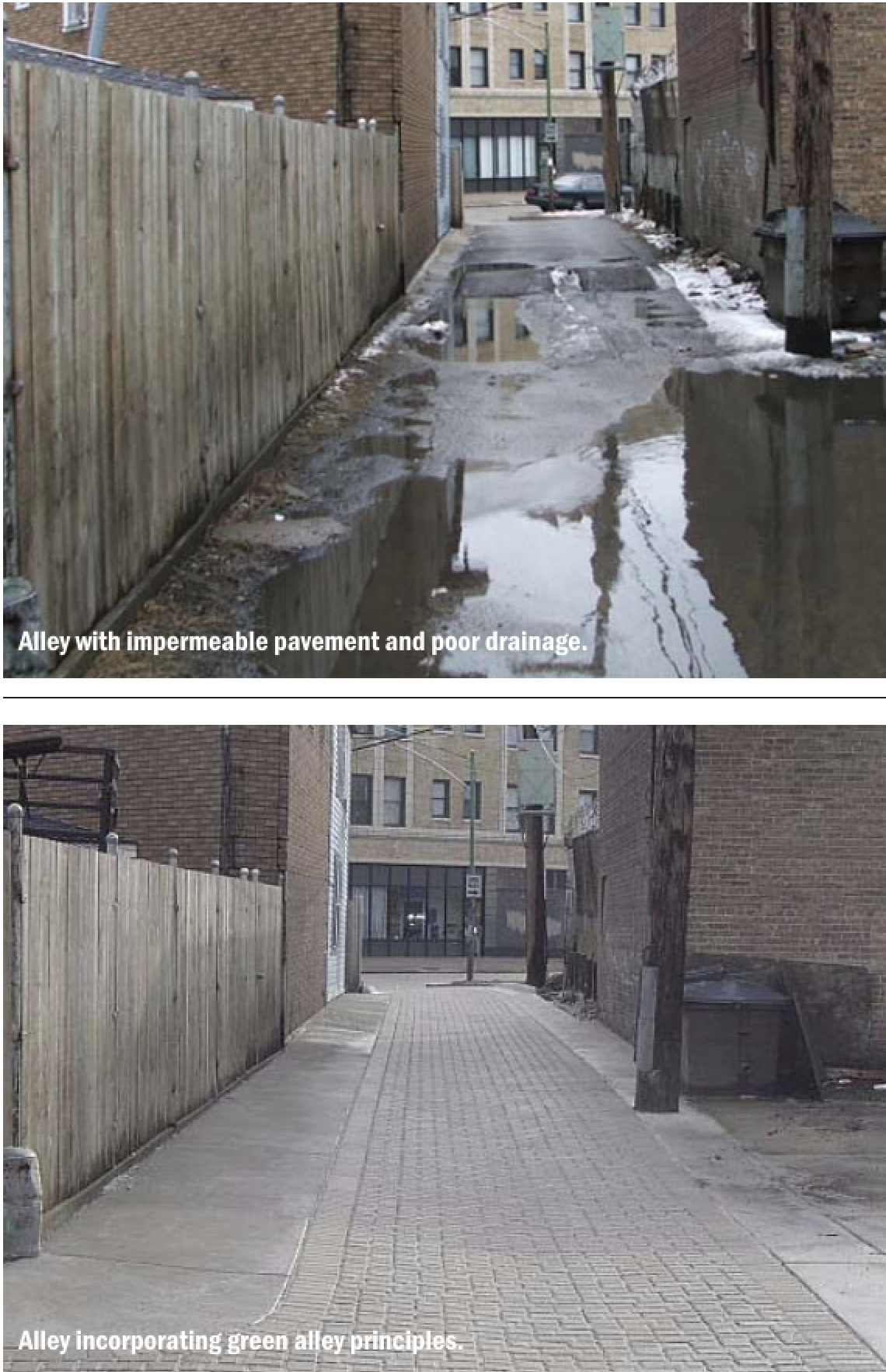
Chicago Alley
In fairness, this option comes with real tradeoffs worth stating. Permeable paver systems typically cost more per square foot to install than a simple planted bumpout, though the gap narrows once a bumpout design also prices in a comparable stone reservoir and underdrain. Both approaches require the same subgrade soil and infiltration testing that any Best Management Practice (BMP) sited to infiltrate stormwater should already require, regardless of design. Permeable pavement also needs periodic vacuum-sweeping or joint maintenance to keep the surface from clogging with sediment, an ongoing cost a planted bumpout does not carry in the same way. That maintenance may be easier to manage here, though, since the surface already carries road traffic and needs no special access.
THE RATIONALE BEHIND THIS
Narberth’s Pollutant Reduction Plan (PRP), the compliance document Pennoni Associates prepared for the Borough’s MS4 stormwater discharge permit, assigns different sediment-removal credit to different types of stormwater practice under Pennsylvania DEP’s "Simplified Method." Stormwater curb bumpouts are credited at 80% sediment removal, the same value given to the Borough’s bioretention swales and facilities. Infiltration basins elsewhere in the Borough are credited at 95%. The one existing permeable pavement installation in Narberth is a privately owned porous paving system at 100 Forrest Avenue, built by a developer as part of a mixed-use project rather than a Borough capital project. It is credited at just 55%, the low end of the range DEP allows for bioretention and rain-garden practices generally.11 Judged strictly by that number, a bumpout looks like the more efficient way to hit the Borough’s mandatory 22,645-lb/yr sediment-reduction target. That is a real, documented, and quantified reason to prefer bumpouts, and it deserves acknowledgment.
That is not the end of the analysis. The 55% figure comes from a single small (0.03-acre), privately built retrofit, credited years ago, and there is no evidence it was ever benchmarked against the broader engineering literature on how permeable pavement performs when properly designed. The EPA’s National Menu of Best Management Practices technical fact sheet for permeable pavements reports measured pollutant-removal rates compiled from five peer-reviewed field studies, including a multi-site survey of permeable pavement installations in eastern North Carolina:12
| Surface type | Measured total suspended solids removal |
|---|---|
| Porous asphalt | 94-99% |
| Pervious concrete | 91% |
| Permeable interlocking concrete pavers (PICP) | 67-81% |
Every one of those ranges, including the low end of PICP performance, exceeds the 55% credit Narberth’s one local example received. Porous asphalt and pervious concrete perform on par with, or better than, the 95% credit the Borough gives its infiltration basins. Nothing in the national performance record suggests permeable pavement is an inherently weaker practice than a curb bumpout. It suggests only that the Borough’s one local data point for permeable pavement was a small, minimally engineered private retrofit, never re-tested against a design built and documented to the same standard as the bumpouts against which it is being compared.
A rationale exists. It is quantified. But it rests on one unrepresentative local example, not a genuine side-by-side comparison of properly engineered alternatives. The Pennsylvania DEP BMP Manual that Pennoni’s project documents cite already lists permeable and porous pavement as a recognized best management practice, alongside bioretention and inlet retrofits.5 A parking-compatible design was available, in use elsewhere at exactly this scale, and performing at least as well by the published numbers. But no record shows anyone modeled it against Wynnedale Road on equal terms before Council’s vote.
WHY THIS MATTERS GOING FORWARD
The two bumpouts on Wynnedale Road were, in the author’s assessment, the wrong decision. Wynnedale Road ranked lowest for environmental benefit among the sites the Borough’s own analysis considered. The Borough chose it without a strong rationale weighing it against a properly engineered parking-compatible alternative, without a plan to measure whether it works, and without evaluating parking-preserving alternatives that other jurisdictions already use at scale and that national performance data suggest could perform just as well or better. That decision does not get better because it has momentum behind it.
Voting to proceed with two more bumpouts on Wynnedale Road, as the first installment of a 25-bumpout program budgeted at up to $730,000 Borough-wide, does not correct that error. It repeats the error, street by street, at rising cost and rising loss of on-street parking. And it does so before anyone outside the Borough’s engineering contractor has had a chance to ask whether a parking-compatible design, built and documented to the same standard as the bumpouts themselves, could deliver the same environmental result. Compounding a bad decision is not the same as validating it. It is doubling down on the error.
Thanks for reading.
All numbers and street names referenced above are drawn from Borough planning documents and engineering plans on file with Narberth Borough.
The views expressed in this article are those of the author and do not necessarily reflect the position of Our Narberth, Inc., its board, or its members.
Engineers’ Estimate of Probable Construction Cost, Pennoni Associates Inc., Project NARBM15019, May 12, 2026. Estimate covers one bumpout location (Wynnedale Rd @ Shady Ln); two locations are proposed. ↩︎
Narberth Borough Five-Year Capital Improvement Plan, CIP Item NARB_CIP_030 (“Construct 19 roadway rain garden bumpouts (5/year)”), last updated May 29, 2026. Est. cost range: $600,000-$730,000; status: Proposed. ↩︎
Narberth Borough Stormwater Bumpout Analysis (undated). Eight completed bumpouts are listed: Conway Ave @ Windsor Ave, N Essex Ave @ Windsor Ave, Forrest Ave @ Windsor Ave, Hampden Ave @ Windsor Ave, Conway Ave @ Stuart Ave, Dudley Ave @ Stuart Ave, and Grayling Ave @ Windsor Ave (two locations). ↩︎
Narberth Borough Stormwater Bumpout Analysis. Of the three locations proposed for 2026, Wynnedale Rd ranks lowest in estimated annual sediment credit (1,285 lb/yr). Dudley Ave @ Price Ave ranks highest at 2,909 lb/yr-more than twice the Wynnedale Rd figure. Numerous other listed locations (e.g., Dudley Ave @ Windsor Ave: 2,909 lb/yr; Conway Ave @ Price Ave: 1,600 lb/yr; Price Ave @ N Essex Ave: 1,527 lb/yr; N Narberth Ave @ Windsor Ave: 2,109 lb/yr; Woodbine Ave @ N Essex Ave: 2,279 lb/yr) also exceed the Wynnedale Rd estimate. ↩︎
Pennsylvania DEP BMP Manual (referenced in Pennoni Associates project documents, Sheet CM6001). The Manual recognizes multiple stormwater best management practices beyond in-road bumpouts, including bioretention areas, rain gardens on private property, and inlet retrofits, among others. See also U.S. EPA, “Soak Up the Rain: Permeable Pavement”, which lists interlocking pavers, pervious concrete, and pervious asphalt as recognized permeable pavement types. ↩︎ ↩︎
Federal Highway Administration, “Tech Brief: Porous Asphalt Pavements with Stone Reservoirs”, April 2015. The brief describes porous pavement with an underlying stone reservoir as providing “a strong pavement surface for parking, walkways, trails, and roads” while managing and treating stormwater runoff. See also Wikipedia, “Permeable paving”, for an overview of permeable interlocking concrete pavement (PICP), pervious concrete, and porous asphalt as distinct product categories with different traffic-load ratings. ↩︎
City of Chicago Department of Transportation, “Green Alley Handbook”, 2010. Describes permeable pavement installed across Chicago’s approximately 1,900 miles of public alleys - surfaces that provide direct vehicle and parking access to abutting garages - as allowing “up to 80% of the rainwater falling on these surfaces” to infiltrate rather than enter the sewer system. See also City of Chicago, “Green Alleys”. ↩︎
D.C. Department of Energy and Environment, “Get RiverSmart”. Describes permeable pavers, alongside rain gardens, green roofs, and rain barrels, as green infrastructure practices incentivized under the District’s RiverSmart programs to reduce stormwater runoff into District waterways and the Chesapeake Bay. ↩︎
susdrain (The Sustainable Drainage community, supported by CIRIA - the Construction Industry Research and Information Association), “Permeable surfacing options”. Presents permeable and porous paving as a standard SuDS (Sustainable Drainage Systems) component used in the UK, including in parking areas, on equal standing with swales, basins, and bioretention as recognized drainage infrastructure. ↩︎
Regenwasseragentur Berlin (Berlin Rainwater Agency, a joint initiative of the Berlin Senate Department for the Environment and Berlin’s water utility), regenwasseragentur.berlin. Promotes “Entsiegelung” (de-sealing of impervious surfaces) and “Versickerung” (infiltration-capable surfacing) as core components of Berlin’s “Schwammstadt” (sponge city) rainwater management strategy, applied to streets, courtyards, and parking areas across the city. ↩︎
Narberth Borough Pollutant Reduction Plan, East Branch of Indian Creek (Pennoni Associates Inc., Project NARB0702, September 2017, revised May 2020), pp. 6-8. DEP’s “Sediment Effectiveness Value” table lists generic removal credits by BMP category (Infiltration Practices: 95%; Bioretention/Rain Gardens: 55-90%; Storm Sewer Filters: 80% max, among others); permeable pavement is not listed as its own named category. In the Borough’s project-specific accounting, Stormwater Curb Bumpouts (approx. 23 locations) are credited at 80% sediment removal (11,770 lb/yr against 8 managed impervious acres); Porous Paving (100 Forrest Ave., a privately owned installation) is credited at 55% (30 lb/yr against 0.03 managed impervious acres); Infiltration Basins at four sites are credited at 95%. Document on file with Narberth Borough and linked from the Borough’s MS4 program page. ↩︎
U.S. EPA, Office of Water, “NPDES Stormwater Best Management Practice: Permeable Pavements”, National Menu of Best Management Practices for Stormwater. Table 1 reports measured total suspended solids removal of 94-99% for porous asphalt, 91% for pervious concrete, and 67-81% for permeable interlocking concrete pavers (PICP), compiled from Barrett, Kearfott & Malina (2006); Bean, Hunt & Bidelspach (2007b) - a field survey of permeable pavement sites in eastern North Carolina; Clausen & Gilbert (2006); Rushton (2001); UNH Stormwater Center (2007); and Van Seters (2007). The fact sheet also notes that 80% total suspended solids reduction is a standard benchmark permeable pavements can earn credit for under voluntary green building standards such as LEED. ↩︎