
A Guide to Narberth Zoning
A plain-language guide to Narberth Borough's zoning code — what form-based codes, conditional use, density bonuses, and recodification actually mean for residents
Aongus Flood
housingNarberthrecodificationADUNarberth zoning changesNarberth form-based codeNarberth 4a 5b zoningsurvey
1107 |5 Minutes, 1 Second
2026-04-03 20:00 -0400
Detours
Maybe bring the highlighter.
If you’ve lived in Narberth for any length of time, you’ve probably heard murmurs about “zoning changes” and “recodification” at borough meetings, on neighborhood corners, or over coffee. You may have nodded along without much idea what anyone was talking about. That’s okay. Zoning affects every property in the borough and yet somehow never made it into anyone’s dinner party conversation, at least until now.
Two things are happening at roughly the same time in Narberth, and people are mixing them up. One is a set of proposed changes to what can actually be built in two specific zoning districts. The other is a recodification of the entire zoning code, a reorganization that doesn’t change the rules at all. Both involve the same document, Chapter 500 of the Borough Code, which is why it’s confusing. This guide is here to un-confuse you.
First, Some Terms You’ll Need
Before we get into the specifics, let’s define some words that zoning zealots throw around as if everyone learned them in school.
Zoning Code
The zoning code is the set of rules that governs what can be built on every piece of land in the borough. It tells you how tall a building can be, how far it has to sit from the street, how much of the lot it can cover, how many parking spaces it needs, and what it can be used for: housing, shops, offices, and so on. Every municipality has one. Narberth’s is Chapter 500 of the Borough Code.
Zoning Districts
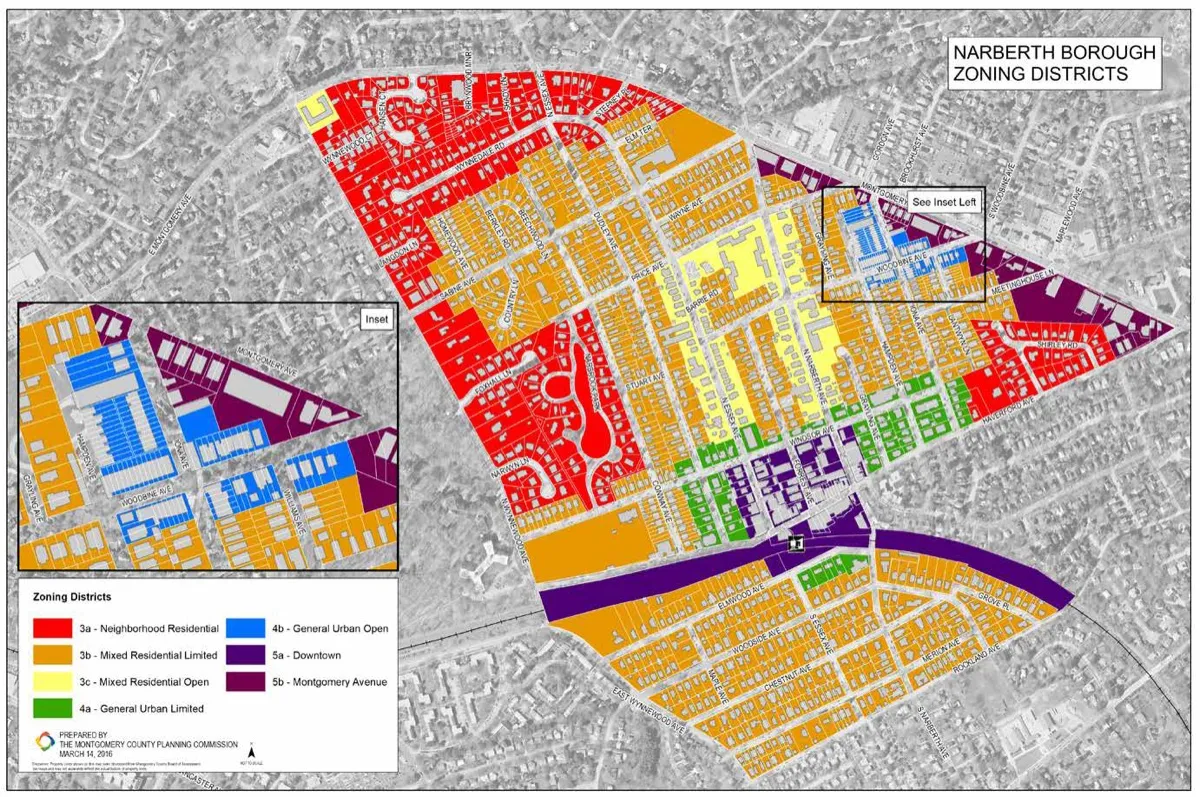
Zoning map
The borough is divided into geographic zones, or districts, each with its own set of rules. Think of them as neighborhoods with different rulebooks. Narberth has seven main districts plus a historic overlay. They range from 3a, the lowest-density residential areas with bigger lots and single-family homes, up through 5b, the Montgomery Avenue commercial corridor. The higher the number, generally, the more intense the permitted development.
Form-Based Code
This is the type of zoning code Narberth uses, and it’s somewhat unusual. Most municipalities in the region use what’s called Euclidean zoning, named after a court case involving the Village of Euclid, Ohio, not the Greek mathematician, disappointingly. Euclidean zoning works primarily by separating uses: houses go here, shops go there, factories go way over there. Its main concern is keeping incompatible uses apart.
A form-based code takes a different approach. Instead of focusing on what happens inside a building, it focuses on what the building looks like and how it relates to the street. How tall is it? How close to the sidewalk? How wide? Does it have a front porch or a storefront? The idea is that if buildings have the right form and placement, a mix of uses can coexist comfortably, an apartment above a shop, an office next to a house, as long as the physical character of the street holds up.
Narberth adopted its form-based code in April 2016, the first of Montgomery County’s 62 jurisdictions to do so. It has been amended more than 15 times since, through various ordinances, which is part of why the recodification is needed (more on that below).
By-Right vs. Conditional Use
These terms describe how easy it is to get permission to build something.
By-right means you can build it as long as you meet the code’s requirements. Submit your plans, meet the rules, get your permit. No public hearings, no special approvals, no discretionary review by elected officials. It’s the zoning equivalent of an ATM: meet the requirements, get the result.
Conditional use means the use is allowed in principle, but you have to go through a public hearing before Borough Council first. Council evaluates your proposal against a set of criteria: is it compatible with the neighborhood? Does it have adequate parking? Will it harm adjacent properties? Council can approve it, deny it, or approve it with conditions. This process adds time, cost, and uncertainty. For a developer, conditional use is a significant hurdle; for neighbors, it’s an opportunity to weigh in.
When the proposed changes talk about making something “by-right” that’s currently “conditional use,” they’re removing that extra layer of review. Whether that’s good or bad depends entirely on your perspective and on what’s being changed.
Density Bonus
A density bonus is a deal the zoning code offers to developers: we’ll let you build more, an extra floor or more units, if you do something the community wants in return. In Narberth’s proposed changes, the something is affordable housing. The developer gets an additional story of market-rate units to sell or rent at full price. In exchange, they must reserve 10% of the units in the building for households earning 80% or less of the Area Median Income (AMI) for Montgomery County. In 2024, 80% of AMI was about $91,000 for a family of four.
AMI (Area Median Income)
The Area Median Income is a number the federal government calculates for each metropolitan area. It’s the income level at which half the households earn more and half earn less. Housing policy uses AMI as a yardstick for defining “affordable”: if you’re at 80% of AMI, you earn 80% of what the median household earns. Housing is considered affordable if it costs no more than 30% of a household’s gross income. Above that, the U.S. Department of Housing and Urban Development considers you “cost-burdened.”
Recodification
Recodification is the process of reorganizing and rewriting a legal code to make it clearer and easier to use without changing what it actually says. If you’ve worked on software, think of it as refactoring: you restructure the code, rename confusing variables, consolidate redundant logic, and improve the documentation, but the program does the same thing it did before. Same inputs, same outputs, cleaner internals.
Missing Middle Housing
You’ll see this term in discussions about Narberth’s zoning. “Missing middle” refers to housing types that fall between single-family detached homes and large apartment buildings: duplexes, triplexes, townhouses, rowhouses, and small apartment buildings. These types were common in older neighborhoods, Narberth included, but many modern zoning codes have effectively banned them or made them very difficult to build. They’re called “missing” because there’s a gap in the housing stock where they used to be.
ADU (Accessory Dwelling Unit)
A small, self-contained housing unit on the same lot as a main house: a converted garage apartment, a basement unit with its own entrance, or a small cottage in the backyard. ADUs are one of the gentlest ways to add housing. They’re typically invisible from the street and use existing infrastructure.
See the next post for details on the current zones 4a and 5b