
What Happens to the Schools? The Question Nobody Has Officially Asked
The 4a and 5b zoning changes could add apartments across Narberth's South Side and Montgomery Avenue corridor. Lower Merion School District has not been asked what that means. Here's why that gap matters more than it sounds.
Aongus Flood
schools4a5bLower Merion School DistrictElmwood
1844 |8 Minutes, 22 Seconds
2026-06-30 20:00 -0400
No school capacity letter exists for the 4a and 5b Planning Commission proposal. The last district enrollment study is from 2018, and it already had 198 Elmwood in its pipeline.
This should have a paper trail: if Narberth Borough Council adopts the proposed changes to the 4a and 5b zoning districts, and apartment buildings start going up across the South Side and the Montgomery Avenue corridor, what happens to Belmont Hills Elementary? Belmont Hills currently serves North Narberth. However, LMSD can send kids anywhere.
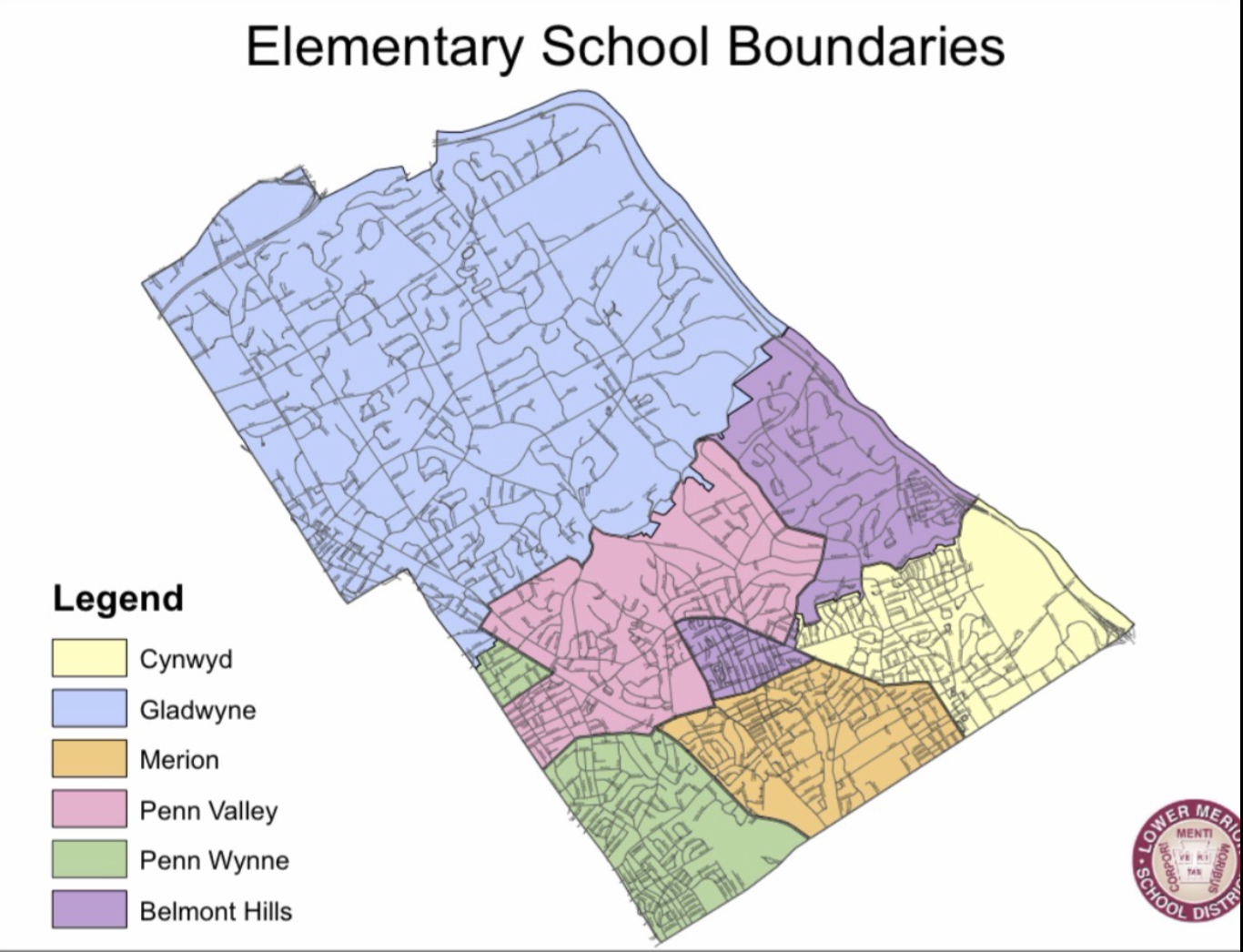
Areas being Served
We went looking for the answer. There isn’t one. Nobody has requested a school capacity letter from Lower Merion School District as part of this proposal. The most recent comprehensive enrollment study the district has on file is from December 2018. That study is good work, and we relied on it heavily for this article, but it is seven years old, and it already lists 198 Elmwood Avenue as a project in the pipeline at 20 units. The Planning Commission is now proposing a framework that could put considerably more than 20 units on that single parcel, on top of every other qualifying lot in both districts, and nobody has gone back to the district that would have to seat these children and asked what that means today.
That is the issue here. Not a prediction of crowded classrooms next September. A missing document that should exist before a vote, not after one.
The math that the Borough has avoided
Belmont Hills, the elementary school that serves Narberth’s North Side, is not currently full. District enrollment data and the 2018 projection model both show it has real room. The best available data on how many schoolchildren new apartments actually produce also cuts against the simplest version of the worry.
The Montgomery County Planning Commission published a demographic study in March 2025 that estimates how many public-school students each type of new housing unit generates, broken out by region and drawn from Census Bureau data.1 For the planning region that includes Narberth and Lower Merion, the study puts new multifamily construction at about 0.04 public-school students per unit. New single-family detached houses, by contrast, generate about 0.63 students per unit in the same region, more than fifteen times as many. A reduced-parking apartment marketed to commuters and downsizing empty nesters is, on the data, not the same animal as a three-bedroom house.
The existing housing stock tells the same story from the other direction. The 2010 Census counted 12,890 children under 18 across 24,095 housing units in Lower Merion Township, about 0.54 children per unit, in a township built overwhelmingly of single-family homes.2 That figure counts every child, not only those enrolled in public school, so it is not a like-for-like match with the 0.04 apartment rate. But the order of magnitude is the point: the housing that gives Lower Merion its schoolchildren is detached houses, and new apartments add students at a small fraction of that rate.
Run the apartment rate against a realistic build-out. Take the county’s higher countywide figure for new rental apartments, 0.09 students per unit, which is deliberately the number least favorable to our own argument.1 Even at that rate, the 50 to 200 new units a conservative reading of 4a and 5b might produce over the next decade would add somewhere between about 5 and 18 public-school students district-wide, not hundreds, and not concentrated in any single September. The figure specific to Narberth’s region is lower still, around 0.04, which would roughly halve those counts. Lower Merion has absorbed far larger swings before: the district added more than 700 students in a single ten-year stretch through ordinary household turnover and existing development, long before anyone proposed rezoning a parcel in Narberth.
The concern
Belmont Hills has slack today. That slack is not a permanent feature of the building. It is a snapshot, taken at a moment before 4a and 5b open up by-right apartment construction across the same blocks that feed that school. The 2018 district study shows exactly how fast a single elementary catchment area can absorb new units once a few sites turn over. Cynwyd Elementary’s attendance area took in 281 new housing units in just five years, 2013 to 2017, almost entirely from a handful of multifamily projects on Bala Avenue and Righters Ferry Road. A school with room one year can be a school managing real pressure a few years later, not because any one building broke it, but because several buildings arrived in the same catchment area inside the same decade.
That is the real risk with 4a and 5b. Not that any single proposed building overloads Belmont Hills by itself. It is that this rezoning does not get evaluated as one parcel at a time.
It opens the door, by right, across an entire district, at the same moment Narberth’s South Side is also absorbing whatever else moves through the pipeline over the same years. Slack that looks comfortable today can disappear the way it did in Cynwyd, and the Borough has produced no analysis of whether that is likely here, because nobody asked the district to produce one.
What should exist and does not
A responsible zoning amendment of this scope should be accompanied by a current capacity letter from Lower Merion School District, built on this proposal’s actual unit counts and density bonuses, not on the 2018 study’s. It should account for the cumulative effect of 4a and 5b development landing on Belmont Hills at the same time as whatever else is already in motion elsewhere in the district’s pipeline. It should say plainly whether the building has room for that combined load, or whether it does not.
That letter does not exist. The Planning Commission’s recommendation has gone forward without it. We are asking, formally and on the record, that the Commission either produce this analysis before any vote or explain in writing why it considers an updated, cumulative school capacity assessment unnecessary for a proposal of this scale. Given that the district’s own planners already knew about the site at the center of this debate in 2018, that is not an unreasonable thing to ask for in 2026.
We would rather make this case with a real answer in hand than with a guess, ours or anyone else’s. Right now, nobody has the real answer. That is a problem, and it is one the Borough can still fix before this goes to a vote.
Pipeline Notes
There is a practice called “address-of-convenience” renting: leasing a small apartment within a desirable school district boundary to establish enrollment eligibility while maintaining a primary residence, or cheaper rental, elsewhere. WHYY’s reporting on Philadelphia’s suburban school districts found that districts remove hundreds, possibly thousands, of students each year for residency fraud. The practice is documented enough that LMSD maintains a formal “Multiple Occupancy Registration” form for families sharing an address with a district resident. The form explicitly states that LMSD may conduct surveillance and home visits to verify compliance, and that false claims can result in criminal prosecution and civil liability for full tuition reimbursement. The existence of that form is itself evidence that the district treats this as a real and recurring phenomenon.
Renter-occupied units account for 37.1% of Narberth’s housing stock (2015-2019 ACS), which is higher than both Montgomery County (28.4%) and Lower Merion Township (26.3%). The rental stock in Narberth is disproportionately large compared with both of those broader geographies. Roughly 770 of Narberth’s roughly 2,077 housing units are renter-occupied. Even a small fraction of those being address-of-convenience rentals represents a meaningful enrollment change.
The apartment yield figures above are regional averages, not Narberth-specific ones. The Montgomery County study’s “KOP Ardmore” region spans far more than Narberth: King of Prussia, Bridgeport, Conshohocken, and much of the lower county, most of it without Narberth’s particular draw, a small walkable borough inside one of the state’s top school districts, a few stops from Suburban Station. If Narberth’s rental housing attracts a distinct subset of renter, families who rent there specifically for LMSD access rather than for price or space, then Narberth’s real yield per rental unit could run higher than the regional average, and the regional figure would understate Narberth’s enrollment impact. The address-of-convenience pattern described above points the same way.
The economic incentive
That incentive is large. The question: how much does a family pay in rent premium to live in Narberth versus the nearest comparable geography outside LMSD? That premium is roughly what they’re paying for school access.
Narberth one-bedroom apartments average approximately $2,200 a month as of 2025, while Upper Darby one-bedroom apartments average approximately $1,100 a month over the same period. The differential is roughly $1,100 a month, about $13,200 a year, for a comparable unit just across the district line. Zumper Narberth, Zumper Upper Darby.
Now compare that to what’s being purchased. LMSD spends $29,930 per student per year. A family with two school-age children is effectively accessing approximately $60,000 a year in educational services for a rent premium of $13,200. Even accounting for the smaller, less comfortable apartment they’re presumably occupying, the economics look favorable next to any private-school alternative. The implied “tuition” calculation is quantifiable and substantial.
The views expressed in this article are those of the author and do not necessarily reflect the position of Our Narberth, Inc., its board, or its members.
Montgomery County Planning Commission, Who Are Our Neighbors? A Demographic Profile of the Occupants of Montgomery County’s Residential Development (March 2025), PDF. The study estimates the number of public-school students generated per housing unit by structure type, tenure, and PUMA region, drawn from 2017-2021 American Community Survey 5-year estimates. Table 7 reports, for the “KOP Ardmore” PUMA (the region that includes Narberth and Lower Merion Township), a rate of 0.04 public-school students per new multifamily unit, against 0.63 per new single-family detached home and 0.40 per existing detached home. Table 8, broken out by tenure, reports countywide averages of 0.06 students per existing owner-occupied multifamily unit and 0.09 per new renter-occupied multifamily unit. The figures used in this article are these Planning Commission estimates; they are regional and countywide averages, not a Lower Merion School District study. ↩︎ ↩︎
U.S. Census Bureau, 2010 Census Summary File 1, Lower Merion township, Montgomery County, Pennsylvania (FIPS 42-091-44976): 57,825 total population (table P1); 12,890 persons under 18 (table P12, summing the under-5, 5-9, 10-14, and 15-17 age bands for both sexes); 24,095 total housing units and 22,473 occupied units (tables H1 and H3). That works out to roughly 0.54 children under 18 per housing unit, or 0.57 per occupied unit, across the township’s existing, largely single-family housing stock. This is a broader measure than the Planning Commission’s “public-school students per unit” figure, because it counts all children under 18, including children under 5 and those attending private school, so it is not directly comparable to the 0.04-0.09 new-multifamily rates cited above. It is included only to show the order-of-magnitude gap between the child yield of the existing housing stock and that of new apartment construction. Figures retrieved from data.census.gov. ↩︎